What Happens During an Emergency Dentist Appointment?


A true dental emergency has a way of shrinking your world fast. A cracked molar from lunch, a swelling that crept up overnight, a front tooth knocked loose on a Saturday afternoon, any one of these can make it hard to think about anything beyond the next hour. When people call an Emergency Dentist, they are usually not looking for a perfect long-term solution on day one. They want the pain to stop, the problem to be contained, and a clear sense of what comes next.
That is exactly how an emergency visit is designed. It is focused, efficient, and centered on urgent care. The appointment is not rushed, but it is targeted. The dentist’s first job is to sort out what is dangerous, what is causing the pain, and what can be stabilized safely in that visit.
Many patients expect an emergency dental appointment to feel chaotic. In a well-run office, it usually feels surprisingly methodical. The process is built around triage, diagnosis, pain control, and immediate treatment when possible. What changes from case to case is the severity of the issue and how much can reasonably be handled in one sitting.
The first few minutes matter more than most people realize
Before you even sit in the chair, the office will usually try to learn a few essentials. If you call ahead, the front desk or clinical staff may ask where the pain is, whether you have swelling, whether there was trauma, whether you are bleeding, and whether you have trouble swallowing or breathing. Those last two questions are especially important. Dental pain can wait an hour or two in many cases. A rapidly spreading infection that affects the airway is a different category entirely.
When you arrive, paperwork tends to be shorter than at a routine new-patient visit, but there are still basics the team needs. Your medical history matters. Medications matter. Allergies matter. If you are on blood thinners, have diabetes, have had joint replacement, or are pregnant, those details can affect what treatment is appropriate that day.
Pain itself also gets assessed more carefully than people expect. Not just whether it hurts, but how it hurts. Throbbing pain that wakes you at night suggests something different from sharp pain when biting, and both differ from a dull ache around the jaw joint. Patients sometimes apologize for being unable to explain it well. They should not. A good Emergency Dentist knows people in pain are rarely at their most articulate.
Triage comes before treatment
The first clinical decision is whether the situation is urgent, emergent, or uncomfortable but stable. Those categories are not just semantics. They guide the order of care.
A broken filling with mild sensitivity may be urgent because it needs prompt attention, but it is not handled with the same speed as a facial swelling with fever. A chipped front tooth that looks dramatic may actually be less serious medically than a back tooth abscess that is not visible at all. This is one reason experienced dentists do not judge emergencies by appearance alone.
If there is obvious swelling, limited mouth opening, drainage, uncontrolled bleeding, or trauma to the face and jaw, the exam tends to become very focused very quickly. In some situations, a dentist will begin with pain control and imaging before doing much else. In others, a visual exam gives enough clues to proceed directly to the likely source.
One practical point surprises patients all the time: the area that hurts the most is not always the tooth causing the problem. Pain can radiate. Upper molars can make the cheek and temple ache. Lower teeth can send pain into the ear or along the jaw. A sinus issue can mimic a toothache, and a cracked tooth can be hard to pinpoint without testing. That is why the appointment starts with investigation, not assumptions.
Expect questions that seem oddly specific
The dentist is trying to narrow the diagnosis fast, so some questions can feel repetitive or unusually detailed. When did the pain start? Was it sudden or gradual? Does hot trigger it, cold trigger it, or both? Does it linger after the stimulus is gone? Does biting make it worse? Emergency Dentist Did ibuprofen help at all? Have you had recent dental work on that tooth? Did you grind your teeth last night? Was there a fall, sports injury, or bite into something hard?
Those questions matter because they point toward very different problems. Lingering sensitivity to heat often suggests the nerve inside the tooth is inflamed or infected. Sharp pain on release from biting can hint at a crack. Gum swelling with a bad taste may suggest an abscess that has begun draining. Jaw soreness without obvious tooth findings can shift attention toward the joint or muscles.
In emergency care, speed is important, but accuracy matters more. Treating the wrong tooth, or treating the right tooth for the wrong reason, creates a second problem when the first one is already bad enough.
The exam is usually brief, but it is not superficial
Once you are in the chair, the dentist will examine the mouth, gums, teeth, bite, and often the surrounding tissues of the face and neck. A true emergency exam can look simple from the outside, but there is a lot of information being gathered at once.
The dentist may tap teeth gently, press on the gums, check for mobility, inspect for fractures, and look for swelling both inside and outside the mouth. If trauma is involved, they will assess whether the tooth is displaced, whether the gum and supporting bone appear injured, and whether nearby teeth were affected even if only one is visibly damaged.
Temperature or vitality testing may be used if the source is unclear. These tests help determine whether the tooth nerve is responding normally, overreacting, or not responding at all. They are not perfect on their own, especially right after trauma, but they contribute useful pieces to the puzzle.
Bite evaluation is another underappreciated part of the visit. Sometimes the problem is not infection or decay but a fractured cusp or a filling that has shifted the bite enough to create severe pain with chewing. In those cases, a small adjustment can bring major relief.
X-rays are common, and often essential
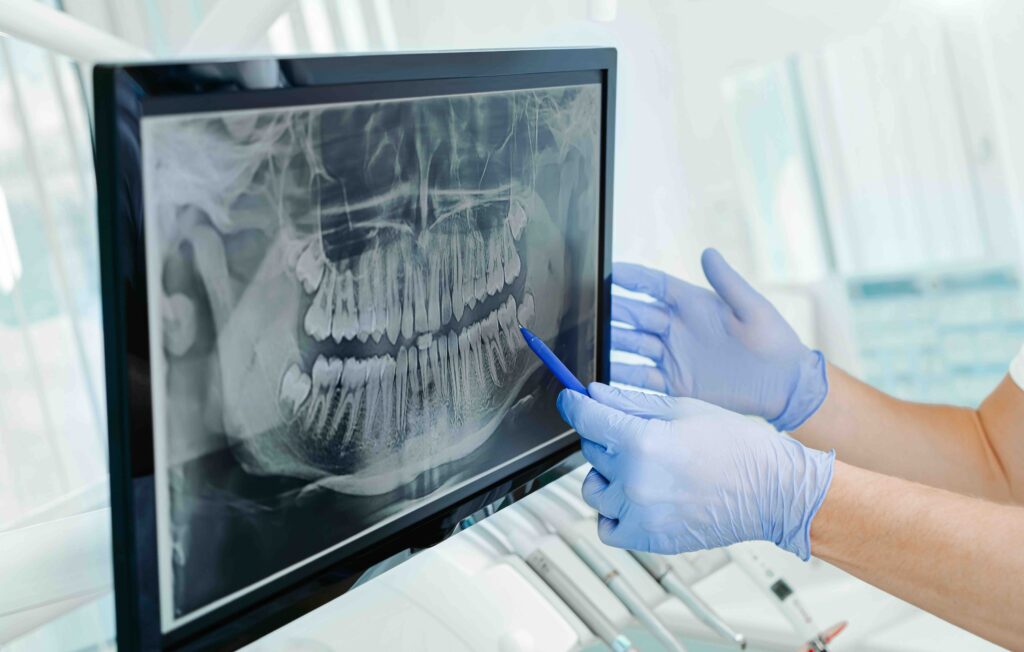
Most emergency appointments involve at least one dental x-ray. That does not mean every problem is visible on the image, but it gives the dentist a way to see decay under fillings, infection around the root, fractures involving the root or surrounding bone, and the condition of prior dental work.
Patients are often surprised when an x-ray does not show much even though the pain is severe. That is not unusual. Cracks, very early nerve inflammation, and some soft tissue issues can be hard to capture clearly. Dentistry often relies on a combination of imaging, symptoms, and clinical tests rather than a single definitive finding.
In trauma cases, the dentist may take several angles to make sure a root fracture or socket injury is not missed. In swelling cases, the image helps determine whether the infection likely started from a tooth, a periodontal issue, or something less straightforward.
When wisdom teeth are the source, the x-ray becomes especially important. A partially erupted wisdom tooth can trap bacteria under the gum and create intense inflammation. Sometimes the answer is temporary management of the infection and pain, followed by extraction planning once the tissues calm down.
Pain relief is usually addressed early
People often assume the dentist will not do much for pain until after the diagnosis is complete. In reality, pain management is part of the diagnosis and treatment process from the start. If the area is very tender, the dentist may numb it early so the exam can proceed more comfortably. Local anesthetic is one of the most effective tools in emergency dentistry, and for patients in severe pain, the relief can feel immediate and dramatic.
That said, numbness is not the same as solving the problem. If a tooth nerve is acutely inflamed, anesthesia can sometimes be more challenging because inflamed tissue changes how well certain anesthetics work. Experienced clinicians adjust technique in those situations. Sometimes that means supplemental injections or approaching the area differently.
Medication decisions are individualized. Over-the-counter anti-inflammatory drugs are often more effective for dental pain than people expect, but they are not right for everyone. Some patients cannot take them because of stomach ulcers, kidney disease, blood thinners, or other medical factors. Antibiotics are prescribed when there is evidence of infection that warrants them, but they are not a cure for every toothache. This is one of the most misunderstood parts of emergency dental care. An antibiotic may reduce bacterial spread, yet it cannot remove a dying nerve, repair a crack, or drain pressure trapped inside a tooth. Many people feel temporary improvement and think the problem is fixed, only to have it flare again days or weeks later.
What treatment can happen that same day?
This depends on the diagnosis, the time available, and how stable the situation is. A common misconception is that an emergency dentist only looks, prescribes, and sends you away. In many cases, definitive or semi-definitive treatment can begin right then.
If the issue is a lost filling or crown, the tooth may be cleaned and restored temporarily or permanently, depending on the damage. If the problem is an abscessed tooth, treatment may involve opening the tooth to relieve pressure, draining infection, starting root canal therapy, or extracting the tooth if it cannot be saved. If a chip is small and cosmetic, the dentist may smooth the edge or place bonding the same day. If a tooth is fractured below the gumline, the visit may focus on pain relief, imaging, and planning for extraction or specialist care.
There is a practical balancing act in emergency dentistry. The ideal treatment is not always the safest treatment in that exact hour. A patient with severe swelling, exhaustion, and limited mouth opening may need the area stabilized first and a longer procedure scheduled once the immediate crisis is under control. Good emergency care is not about doing everything at once. It is about doing the right thing at the right time.
If the problem is an infection
Dental infections are one of the most common reasons people seek urgent care, and also one of the most variable. Some remain localized around the tooth for a while. Others spread into the gum, cheek, or deeper tissue spaces. That range is why a dentist pays such close attention to swelling, fever, swollen lymph nodes, and difficulty opening the mouth.
For a localized infection, the emergency visit may include numbing the tooth, opening it to release pressure, cleaning the area, and placing a temporary medicated dressing. Sometimes a small incision is needed to drain a gum abscess. If the tooth is not restorable, extraction may be the most direct solution.
If the infection appears to be spreading, the tone of the visit changes. The dentist may still begin treatment, but they may also coordinate more urgent follow-up or refer you for hospital-based care if airway risk, dehydration, or extensive swelling is a concern. Most dental infections do not reach that point, but when they do, prompt escalation matters.
One thing patients often mention after treatment is how quickly the pressure changes. The pain may not disappear instantly, but once drainage is established or the inflamed pulp is addressed, the deep, pounding sensation often eases substantially.
If the problem is trauma
A sports injury, fall, elbow to the mouth, or car accident can create a very different emergency appointment. Here, the clock matters. A knocked-out permanent tooth has the best chance of being saved if it is replanted quickly. A tooth that has been pushed inward, outward, or sideways needs rapid evaluation. A broken front tooth may involve only enamel, or it may expose the nerve.
During a trauma appointment, the dentist checks more than the obvious injury. Adjacent teeth are tested. The gums and lips are inspected for embedded fragments. The bite is reviewed. The supporting bone is assessed with imaging. Sometimes a tooth looks intact but has a root fracture or ligament injury that changes the prognosis entirely.
If a permanent tooth has been avulsed and brought in properly, often in milk or a tooth preservation solution, the dentist may replant and splint it. If the tooth is loose or displaced, a flexible splint may be placed to stabilize it while the tissues heal. If a tooth is fractured and the nerve is exposed, urgent protective treatment can reduce pain and improve the odds of preservation.
Trauma cases also come with a lot of uncertainty. A tooth can pass its initial tests and still develop nerve problems later. That is why follow-up after emergency treatment is not optional. It is part of the treatment itself.
If the source is not a tooth at all
Not every patient who sees an Emergency Dentist has a tooth problem. Jaw joint flare-ups, muscle spasm from clenching, sinus pain, ulcerations, and gum infections can all mimic dental emergencies. An experienced dentist keeps those possibilities in mind.
I have seen more than one patient convinced they needed a root canal when the real issue was a cracked nightguard, heavy grinding, and inflamed jaw muscles after a week of poor sleep. I have also seen patients assume they had sinus pressure when the actual problem was a silent infection in an upper molar. This overlap is why examination and imaging are worth doing before jumping to treatment.
When the problem is not dental, Emergency Dentist a good emergency visit still has value. You leave knowing what has been ruled out, what is most likely going on, and whether you need dental treatment, medical treatment, or both.
Temporary fixes are common, and they are not second-rate care
Some emergency visits end with a temporary crown, a temporary filling, a sedative dressing inside a tooth, or a short-term splint. Patients occasionally hear the word temporary and feel disappointed. They should not. In emergency dentistry, temporary often means strategic.
A sedative filling can calm a badly irritated tooth until the nerve treatment is completed. A temporary crown can protect a fractured tooth from breaking further. A bite adjustment can stop pain from a high restoration even if additional work is still needed later. The goal is to move you out of crisis and into a controlled treatment plan.
There are times when definitive treatment the same day is ideal, and times when it would be too aggressive. That judgment call is part of what separates thoughtful emergency care from simply reacting to symptoms.
You will probably leave with a clear next step
One of the biggest jobs of the appointment is helping you understand what happens after you walk out the door. If the treatment solved the issue completely, the next step may be routine monitoring. More often, there is follow-up.
That might mean returning for completion of a root canal, seeing an oral surgeon for extraction, having a crown made after a temporary repair, or coming back for the dentist to reassess healing. If swelling was present, the office may want to check that the infection is resolving. If trauma occurred, repeated testing over weeks or months may be necessary because teeth do not always declare their long-term status immediately.
The aftercare instructions are usually straightforward, but important. How long the numbness will last, what level of soreness is normal, whether you should avoid chewing on that side, what to do if the temporary material comes loose, and what warning signs justify calling back, these details can spare you a lot of anxiety later that evening.
Cost, timing, and why emergency care feels different from a routine visit
Emergency dentistry tends to compress decision-making. At a routine appointment, there is often time to discuss several options at leisure. During an urgent visit, the focus is narrower: stop the pain, prevent the situation from worsening, and choose the safest realistic intervention.
That can affect cost structure too. Charges usually reflect the emergency exam, x-rays, and whatever treatment is performed that day. The total can vary widely depending on whether you need a simple palliative adjustment or a more involved procedure such as drainage, extraction, or root canal initiation. Most offices will explain the immediate costs before proceeding whenever possible, though truly urgent medical situations sometimes need to be addressed without much delay.
Patients occasionally worry that going to an Emergency Dentist means they will be pressured into extensive treatment. In a reputable practice, the opposite is more common. The conversation tends to be practical and prioritized. What must happen now, what can wait briefly, and what gives the best chance of preserving the tooth or resolving the infection.
How to make the appointment go more smoothly
If you are able to prepare, even for ten minutes, it helps. Bring a list of medications, your medical conditions, and your dental insurance information if you have it. If you have a broken tooth fragment, crown, or appliance, bring it with you. If there was trauma, note the time it happened. If you took pain medicine already, know what you took and when. These small details save time and can influence treatment.
If the tooth was knocked out, handling matters. Pick it up by the crown, not the root. If it is dirty, rinse it gently with milk or saline if available, not by scrubbing. Keeping the tooth moist improves the odds. That kind of first-aid step can make a real difference before you ever reach the office.
What most people remember afterward
Patients usually remember two things most clearly. First, the sense of relief when someone identifies the source of pain and explains it plainly. Uncertainty amplifies dental anxiety. A diagnosis, even when the fix is not simple, gives people solid ground again. Second, they remember that the visit was more systematic than they expected. It was not just a quick look at a bad tooth. It was an assessment of pain, infection risk, structural damage, and the safest immediate path forward.
An emergency dental appointment is not meant to feel routine, because it is not routine. But it should feel organized, purposeful, and centered on the problem that brought you there. If you are in pain, that is what competent emergency care looks like: calm triage, careful diagnosis, timely relief, and a plan you can actually follow once the immediate crisis has passed.